The first time, one of you gave a bit and it worked out. It felt like a good sign about the two of you.
This time you have both arrived with the same opening line — "I gave in last time" — and neither of you is moving. The process that worked before has stopped working, and the reason is that it was never really a process.
Why round two is harder
Two things changed.
The favorite is spent. Whichever of you loved the first name most has already had their best outcome, and the other one is carrying a memory of conceding. Both of you are negotiating from a different position than last time, whether or not either of you has said so.
And there is now a history. The first naming produced a result that one of you privately files as a loss, and any decision made against a scoreboard is no longer really about the thing being decided.
"I gave in last time" is a trap
It sounds like fairness. It is actually turn-taking, and turn-taking is a bad way to name a child.
The problem is that it makes the winner arbitrary. Whoever conceded most visibly last time now has the stronger claim, regardless of how much either of you actually cares about the names on the table. The child ends up with whichever name was attached to the better grievance.
It is also unfalsifiable. Both of you can believe it, honestly, at the same time — conceding is much more memorable than being conceded to, so each of you has a clearer record of your own compromises than of the other's.
The way out is not to litigate who really gave in. Nobody wins that and it takes a week. It is to stop treating this name as the settlement of the last one.
Constraints that actually apply
Some of what you are arguing about is real and some is not. The genuinely real one is that this name has to live beside the first.
The 2013 research on sibling names — which found that parents substitute similar-sounding siblings' names far more often than dissimilar ones — is about the only hard constraint anybody has evidence for. Names that share a shape get confused, for twenty years.
Almost everything else in a second-name argument is taste presented as a rule. "It doesn't go" is usually "I don't like it," and the conversation gets shorter once that is admitted.
A fair process when you are stuck
Structure beats willpower here. When neither of you will move, use a method rather than a conversation:
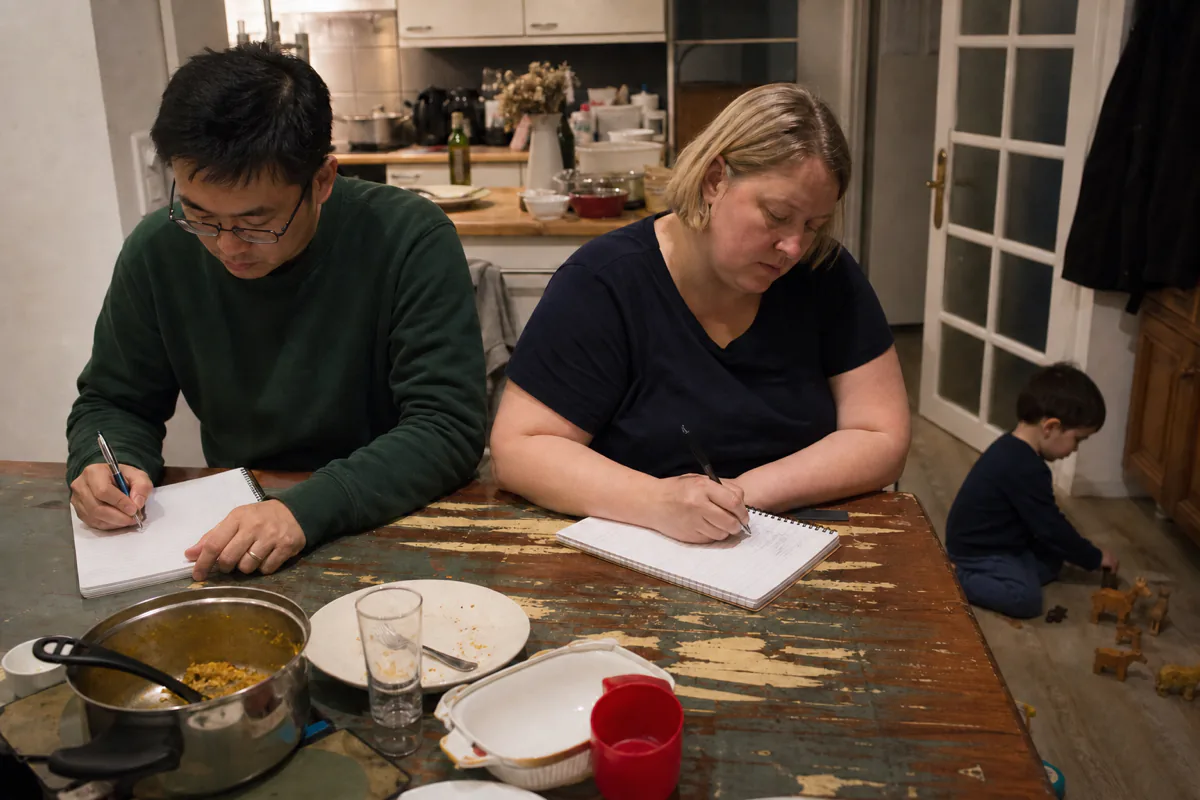
- **Separate lists, written alone.** No conferring, no reacting. Ten names each, no explanations.
- **Mutual veto, no justification.** Either of you can strike anything. A veto you have to defend is not a veto.
- **Whatever survives is the real field.** If that is two names, you are nearly done. If it is zero, the lists were too short, not the marriage too broken.
- **A walk-away rule.** Twenty minutes, then stop for the day. Naming decisions made past the point of tiredness are the ones that produce a grievance.
- **An external deadline.** The registration date, not a person. Nobody has to be the one who forced it.
The point of the veto being free is that it takes the fight out. Neither of you has to argue a name down — you just remove it, and nobody has to lose an argument in front of the other.
Fairness between two children is not measured one name at a time.
The longer view
If you have a third, the scoreboard will still be there, and it will be worse. Which is a decent argument for settling the principle now rather than the instance.
The principle worth agreeing on is that a name is not compensation. Neither of these children is a consolation prize for the other one, and any process that produces a name as a payment has already gone somewhere you do not want it to go.
Get the method right once and it will cover the third name, the schools, and every large decision after that. That is a considerably better outcome than winning this one.