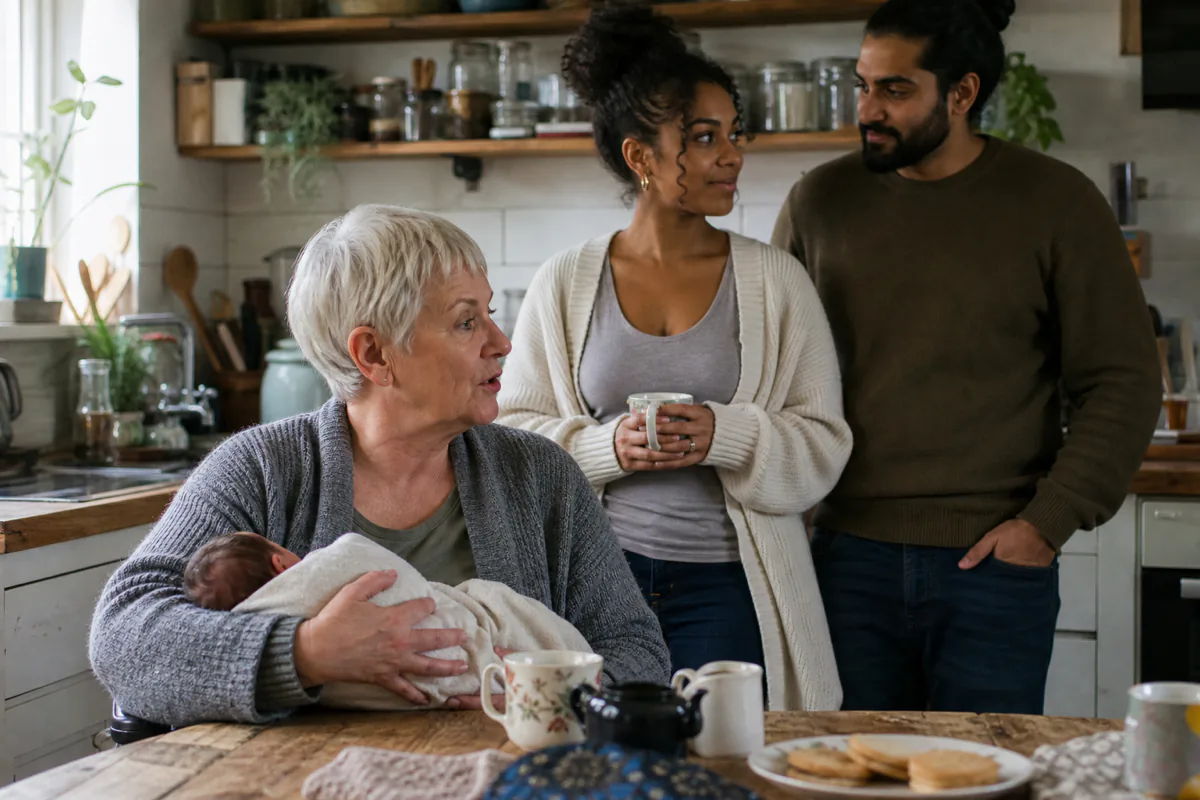
There is a difference between a relative who does not much like the name and a relative who has decided it is not happening. The second one arrives with a tone of correction, as if a mistake has been spotted in time.
That is a harder problem, and it is not really a naming problem. It is about who gets to decide, which is why the first move is not the conversation with them.
Why grandparents feel entitled to weigh in
Naming has been a family act for most of human history rather than a private one. In plenty of traditions the name was never the parents' alone to choose, and grandparents in particular often expect the line to continue through them.
Some of that is still live. Newsweek, reporting on family naming pressure, notes that a substantial minority of American parents — roughly a quarter — name a child after a relative. Where that expectation exists and is not met, it is often experienced as a decision about the relative rather than about the name.
The traditions themselves also disagree with each other, which is worth knowing before anyone claims theirs is the rule. Ashkenazi Jewish custom generally names a child after a relative who has died; Sephardi custom often names after the living. Two families, two opposite conventions, both described by the people inside them as simply the way it is done.
So a naming rule stated as an obligation is usually one family's practice, not a universal one.
The two of you first
This is the whole article, really. Before you answer them, answer each other.
A relative pushing on a name almost always finds the gap between the two of you, because there usually is one — one of you loves the name more, one of you is more afraid of the fallout. If they get to that gap before you have talked, the conversation stops being about the name and becomes about which of you can be worked on.
So: decide together what your actual position is, agree who says it, and agree that neither of you moves without the other. Then answer them.
Traditions you can honor without surrendering
There is often a real middle, and it costs nothing:
- The middle name. This is what middle names have historically been for, and it satisfies most family expectations completely.
- A variant. The same root, updated — the tradition is intact and the name is yours.
- The initial rather than the name. Common in several traditions and widely accepted within them.
- A second child. "Not this one" is a much softer answer than "never."
Offer this if you want to. Do not offer it as a concession under pressure — offered freely it is generous, offered under pressure it establishes that pressure works.
The boundary, said once
If there is no middle and they will not let it go, the sentence is short: "This is the name. We'd love you to use it."
Then stop. Do not justify, do not produce the etymology, do not point out that their own name was unusual in 1954. Every additional sentence is a handle.
If they still refuse to use it, you have a relative with a problem rather than a naming decision to revisit. Their discomfort is genuinely uncomfortable and it is also survivable, and it is theirs.
A relative's approval is not one of the things a name needs.
The part people underestimate
How you handle this gets watched, by each other. A partner who sees you hold the line under pressure from your own mother learns something they will remember for years, and so does one who sees you fold.
The name is the small thing here. The precedent is the large one, because there are twenty years of decisions behind it and this is the first time anyone has tested whether the two of you answer as one.