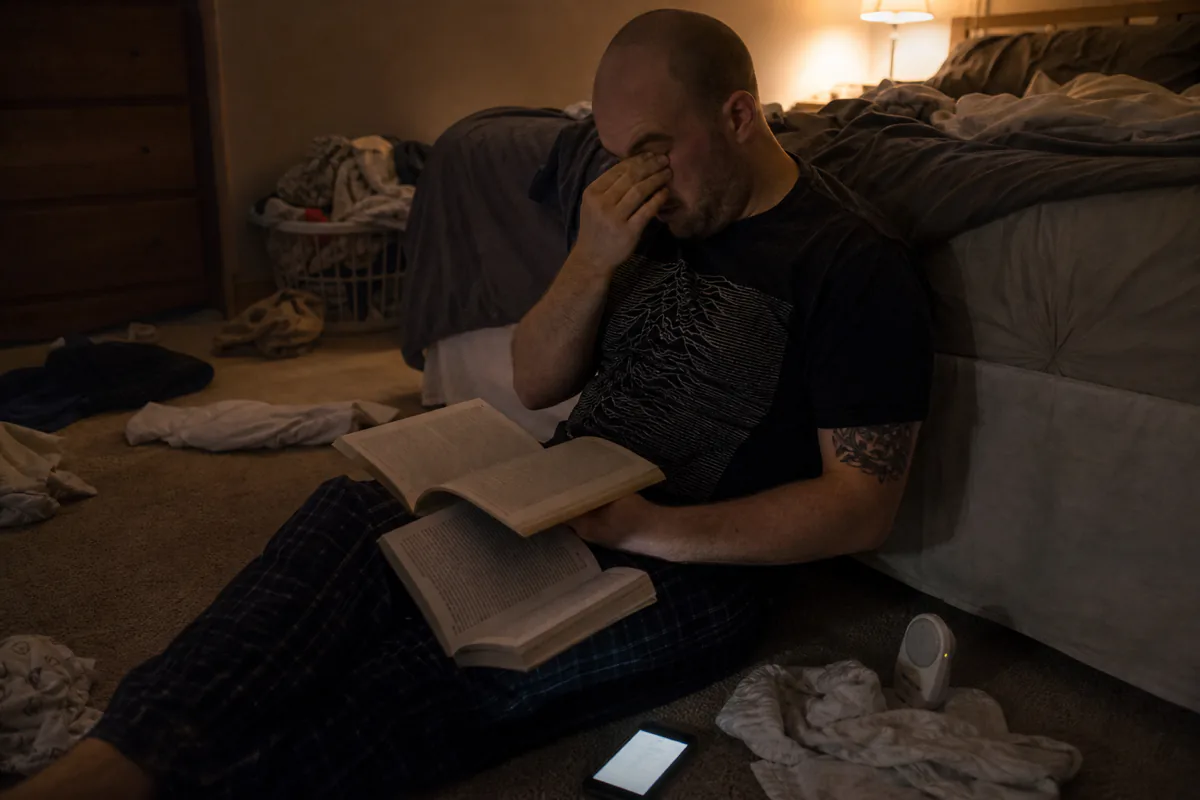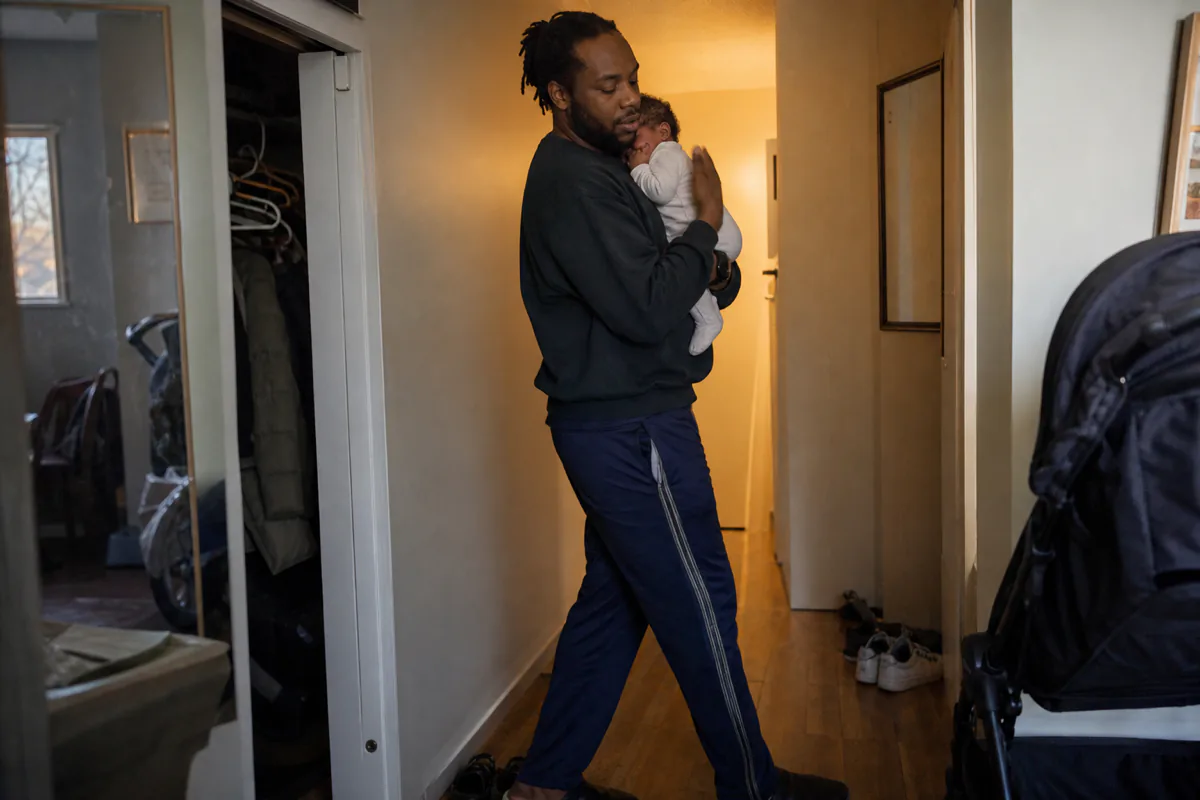
It starts around teatime. You feed, change, rock, walk, sit down, stand up, try the sling, try the pram, try the thing that worked yesterday, and none of it lands. It goes on for hours. Then, at some point, it stops for no reason you can identify.
Two things are worth knowing about this. It has a documented shape, and the fact that nothing worked is part of that shape rather than evidence about you.
The crying has a shape
The clearest description comes from Dr Ronald G. Barr's work, published by the National Center on Shaken Baby Syndrome as the Period of PURPLE Crying.
The pattern it describes: crying begins to increase at around two weeks, peaks during the second month, and then decreases through months three to five.
You will see the peak described elsewhere as six to eight weeks — the Cleveland Clinic and the NCT both cover the same window. That is the same finding stated two ways, not a disagreement.
The important word is peaks. It is a curve with a top and a downslope, and you are somewhere on it.
Why "resists soothing" is normal
The R in PURPLE stands for exactly that: resists soothing. It is listed as a feature of the period, not as a warning sign.
This is the part that does the most good to hear, because the private version of this experience is not "my baby is crying." It is "my baby is crying and I cannot fix it, and other people seem to be able to fix theirs."
They cannot. During this period, for some babies, there is no move that reliably works. Running out of things to try is not the same as having failed to find the right one.
The names people use
You will hear this described as colic, as the witching hour, as the evening fussies, as PURPLE crying. Largely these are different labels attached to the same observed pattern, arriving from different traditions.
Knowing that saves you a certain amount of searching. When one site says colic and another says normal developmental crying, they are often looking at the same evening.
The one rule everyone agrees on
There is a single piece of guidance that every source states without qualification, and it is the reason the PURPLE framework exists at all.
Never shake a baby. If you feel yourself getting to the end of what you can manage, put the baby down somewhere safe — a cot, on their back — walk out of the room, and let them cry while you get yourself back.
The National Center on Shaken Baby Syndrome is explicit that walking away for a few minutes is a safe thing to do, and that reaching that point does not make you a bad parent. It makes you a person who has been awake for six weeks.
Tell whoever else looks after the baby the same thing, including grandparents and anyone helping overnight.
This period ends. The crying peaks in the second month and reduces from there — it is a curve, and you are on it.
What this article is not
There is nothing here about treatments, drops, feeding changes or causes. That is not evasion — it is that the evidence on those is genuinely contested, and it needs somebody who has met your baby.
If the crying is accompanied by anything that worries you, or if your instinct says this is different rather than just hard, that is a call to your midwife, health visitor or doctor. Noticing the change is your job. Working out what it means is theirs.
And if you are reading this at 6:40pm with a screaming baby, the only two things worth taking away are that the curve comes down, and that putting them down safely and stepping outside the door for two minutes is always allowed.