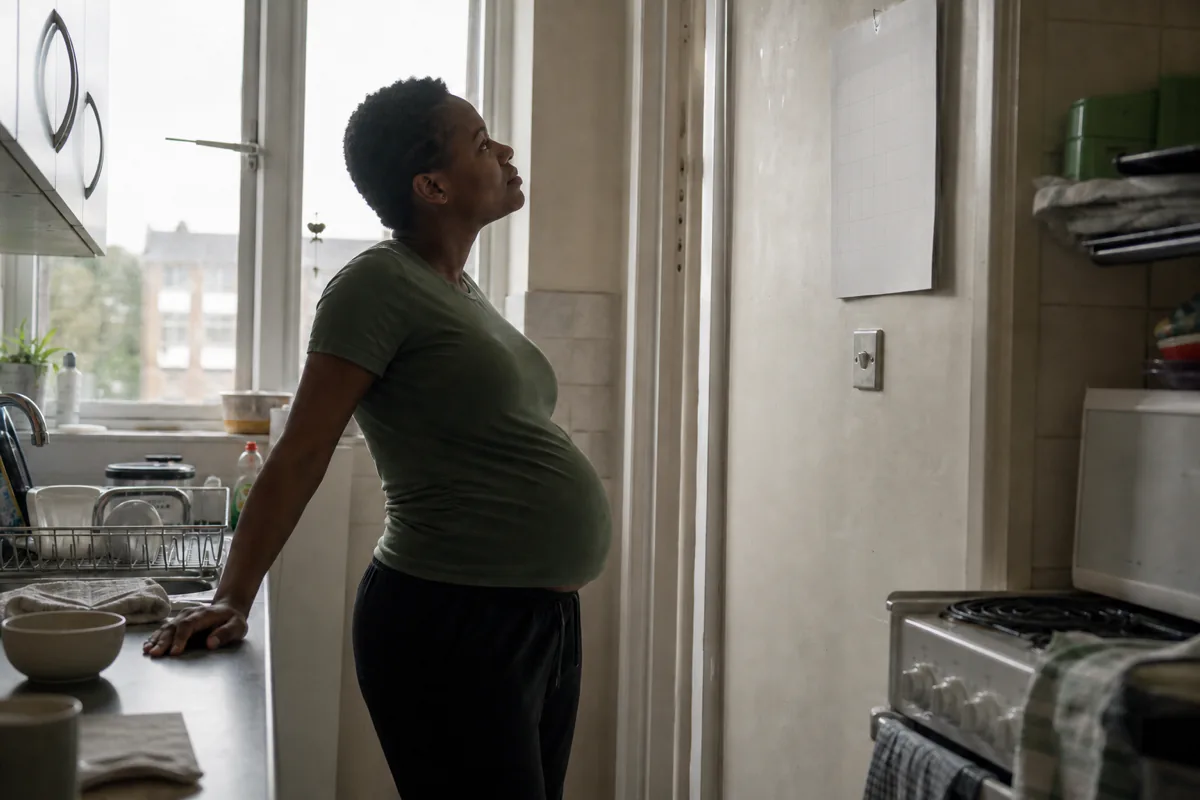
You get one date. It goes on the notes, into the app, onto the calendar, and into every conversation for the next six months. And then everyone who has already done this tells you not to put too much weight on it, without ever explaining why.
Here is the why.
Where the date comes from
The standard method is older than ultrasound. Take the first day of your last period, add 280 days, and that is the date. It is called Naegele's rule, and it has been in use since the nineteenth century.
It works by assuming two things about you. That your cycle is 28 days, and that you ovulated on day 14 of it. Johns Hopkins Medicine describes the calculation in exactly those terms, and the American College of Obstetricians and Gynecologists sets out the dating methods in its Committee Opinion 700.
Both assumptions are averages. Neither is a measurement of you.
Why the honest answer is a range
In 2013 a research team led by Anne Marie Jukic published a study in Human Reproduction that did something unusual: it measured the length of pregnancy from ovulation rather than from a period, using daily hormone samples. That removes the guesswork about when conception actually happened.
The median came out at 268 days — 38 weeks and 2 days from ovulation. And once they excluded every preterm birth, the remaining pregnancies still spanned 37 days from the shortest to the longest.
Thirty-seven days. Five weeks of normal, after taking the early births out.
Only about one in twenty arrives on the day
Roughly five percent of babies are born on their due date. Around ninety percent arrive within two weeks either side of it.
Which means the single most likely outcome, by a distance, is that your baby does not come on the date everybody has written down.
The date is not a prediction of one day. It is the midpoint of a range that nobody prints, because a range is harder to put in a form field.
The same pregnancy, counted three ways
If you have family in France, this one causes real confusion, and it is worth getting straight.
In the United States and across the UK and Ireland, a pregnancy is counted in weeks from the first day of the last period, and full term is described around 40 weeks.
France counts in semaines d'aménorrhée — weeks of amenorrhea, abbreviated SA. That is measured from the same starting point: the first day of the last period. But the French convention puts term at 41 SA, and only calls a pregnancy post-term from 42 SA. On the same clock, that is a week later than the number you were given.
Then there is a second French figure, semaines de grossesse, counted from conception instead. It runs two weeks behind the SA number, so the same pregnancy can be described as 41 SA and 39 weeks in the same conversation.
Three numbers, one pregnancy, and none of them wrong. If a relative tells you that you are counting it incorrectly, ask which of the three they mean.
What actually narrows it down
The dating scan does. Both the NHS and ACOG treat an early ultrasound measurement as more accurate than a last-period calculation, which is why the date sometimes moves after that first scan.
That scan is usually offered between 11 and 14 weeks. A date that changes at that appointment has not gone wrong. It has been measured instead of estimated.
A due date that moves after the scan is the system working, not a warning sign.
What this is not
Nothing here is guidance about induction, about how long is too long, or about what to do if you pass the date. Those are conversations with your own midwife or doctor, who know things about your pregnancy that a website cannot.
This is only about the number itself — where it came from, and how much certainty it was ever entitled to carry.
It is one day, chosen by a formula, standing in for a range of about five weeks. Treat it as the middle of a window, and most of the anxiety attached to it has nowhere to sit.